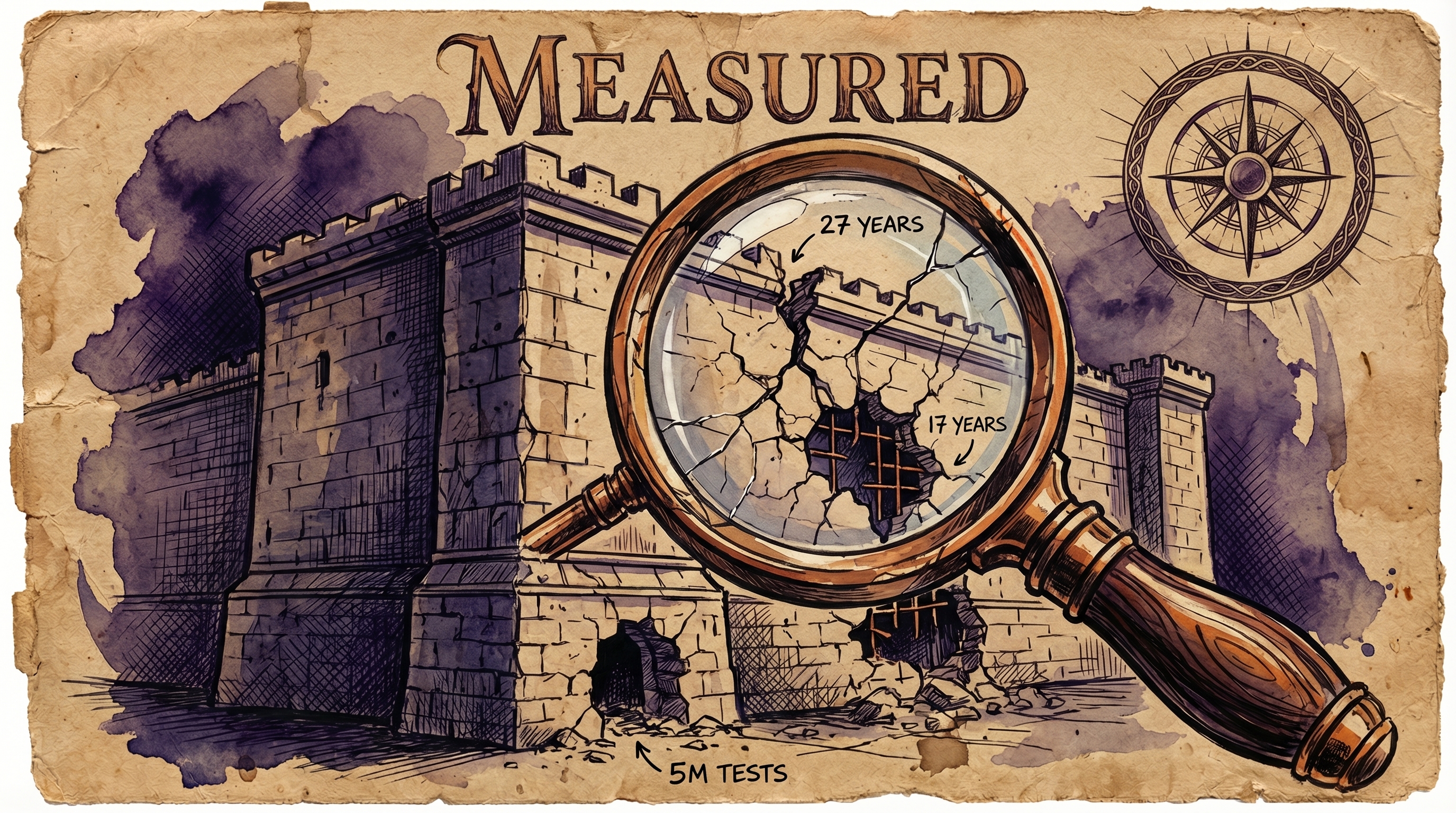
🧭 A 27-year-old bug in OpenBSD. A 17-year-old root access hole in FreeBSD. An FFmpeg flaw that survived five million automated security tests.
These weren’t created by AI. They were always there.
Mythos just found them.
When Anthropic’s most powerful model was pointed at the world’s most trusted software, it didn’t need to invent new attack techniques. It looked at what was already broken — and it kept finding more.
Thousands of zero-day vulnerabilities. Across every major operating system. Every major browser. Software that billions of people use every day, that passed decades of human code review, automated scanning, and compliance audits.
And none of it caught what a model found in hours.
I’ve spent 25 years telling CISOs in Latin America the same thing: your vulnerability count is not your risk posture. Fourteen thousand critical findings on a dashboard tells a board nothing. It’s noise dressed as diligence.
Mythos proved that empirically — at a scale no human team ever could.
This is where FAIR — Factor Analysis of Information Risk — becomes the only framework that makes sense of what just happened.
FAIR doesn’t ask “how many vulnerabilities do you have?” It asks four different questions:
↳ What could happen — specifically? Not “we might get breached.” A ransomware event hits your logistics platform. A misconfigured cloud bucket exposes customer PII. A 17-year-old FreeBSD vulnerability gives an attacker root access to your NFS infrastructure. ↳ How often could it happen? Mythos just changed that number for every organization on earth. Vulnerabilities that sat undiscovered for decades are now findable in hours. The frequency input of every risk scenario you’ve ever modeled just shifted. ↳ If it happens, what does it cost? Not “a lot.” A range. Legal fees, business interruption, regulatory fines, reputational damage — modeled, not guessed. ↳ What controls are actually in place — and do they work? Not a checkbox. A real assessment. Because Mythos just proved that the controls we trusted passed over the same flaws for 27 years.
The media wants to talk about whether AI will “hack the world.” The Pentagon is arguing about who controls the model. LeCun says it’s overblown. NBC is calling it “Vulnpocalypse.”
None of that is the real story.
The real story is that our baseline — the thing we’ve been defending, investing in, and reporting on to boards for decades — was never what we thought it was. And the only way to understand what that actually means, in dollars and probability, is to run the FAIR analysis.
We told ourselves our controls were working. Mythos showed us the inputs we fed into every risk model were wrong — the vulnerability was higher, the resistance strength was lower, and the threat capability was greater than anything we’d calibrated against. FAIR is how you measure the distance between what you assumed and what’s real.
🦑 THE MODEL ISN’T THE THREAT. THE MIRROR IS.
A CISO who walks into the boardroom after Mythos with the same vulnerability dashboard is no longer presenting risk — they’re presenting fiction. The board needs loss scenarios, probability distributions, and financial ranges. That’s FAIR. That’s the work.
What does your board think your security posture is — and did anyone run the numbers, or did they just count the greens?